A Connection to the Land
One who knows me well has remarked that I can become obsessed with the details of a historical mystery. This is true. This trait may account, in part, for my success to date in uncovering nuggets of family historical treasure. My obsession is especially acute when it comes to the place(s) where the drama of my ancestral family’s lives unfolded.
As I reckon it, indeed, to understand the whole story of our history we must answer the questions: Who? What? Where? When? How? And most significantly, Why? But where and when an event transpired is indeed essential and suggestive of answers to the other questions. The place—“the where”—a family tree is planted gets in at its root and works its way out in the branches for all the later generations even if we, the terminal buds of the family tree, are unaware of the soil from whence we sprang. I sometimes say that describing my Southern roots as “rural Alabama and woodland Florida” is redundant since much of this theater in the nineteenth century was and remains agrarian. Even though I may now live in the city, far from the woods and streams of my ancestors, a sense of the soil still pervades my spirit. Thus, I agree with Wendell Berry when he said, “The soil is the great connector of our lives, the source and destination of our lives.”
What is more, I write this post in the hope that the information that I have uncovered in my research will not be lost again to the descendants of our common Moates ancestors. Thus, I will apologize to you, dear reader, in advance for the extreme level of detail within. I hope you will find the facts and ideas provocative and inspiring. Many conjectures are as yet unproven and may exist only as theories, visions, and imaginings. I, of necessity, must leave the adding of final details to those who come after me. Hopefully, this post will assist that family historian in her research.
Nevertheless, I have found helpful the locating the property where my ancestors resided in reconstructing the story of the lives of our forebears. Indeed, the few precious times when we have identified the precise spot on the earth where they stood or walked, and when we tread that spot ourselves has imparted an emotional, almost spiritual sense of the place. Thus, I am impelled to find, if possible, any trace of the habitation of my ancestors on the land.
I have previously reported (see https://sammatteson.com/2023/06/17/hiraeth ) my adventures in exploring the Alabama home place(s) of my mother’s Moates grand- and great-grandparents, the family of patriarch Noah Moates and his faithful wife Elizabeth Harriet Pilcher Moates, both of Huguenot stock from Abbeville County, South Carolina. Noah, like the Biblical patriarch Abram (meaning “exalted father”) who abandoned Ur for lands unknown, sought out a “land flowing in milk and honey.” From my research I conclude that my Patriarchal Noah ultimately found such a place near the confluence of White and Folkes (or Folks) Creeks in the Euchee Valley of Walton County, Florida. And like Abram (aka Abraham) his family accompanied him on his Odyssey.
1843-1850 Alabama Fever Abates
On 3 Nov 1843, my great grandfather James Marion was born (sadly, out of wedlock) to Rachel Moates, near Briar Hill, Pike County, Alabama. I have examined the details of the patrimony of my mother’s granddaddy James Marion Moates (aka Miley). (See https://sammatteson.com/2020/08/30/tell-me-thy-name / and subsequent posts) His birth must have been a scandal in the small community and in near-by Pisgah Primitive Baptist Church (a log structure replaced in the early twentieth century by a quaint Neo-classical structure).
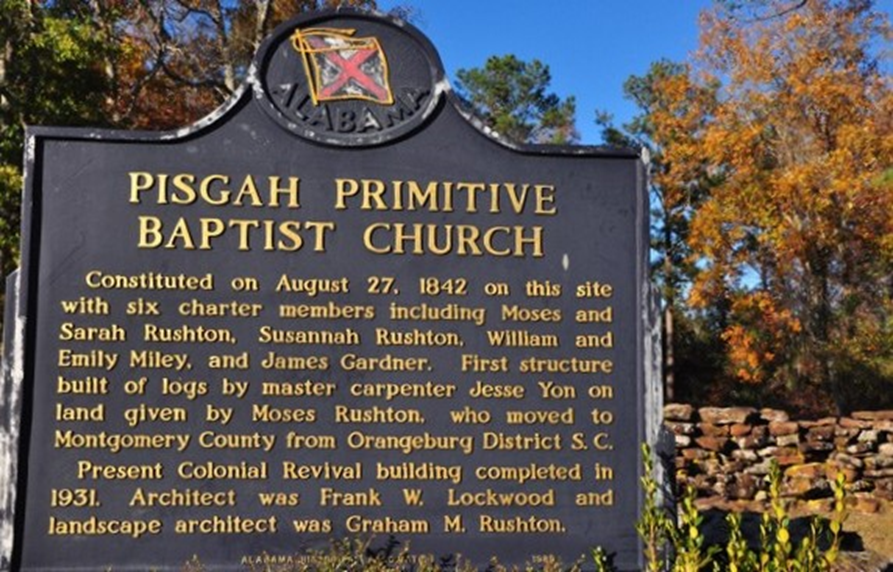
James’ alleged father, William Goodman Miley, was an important church leader (see historical plaque) and a co-founder of the church. In about 1846 Squire Miley absconded with his family to the Tampa Bay area without publically acknowledging his “natural” son—as far as can be established. There he, described as a “hardy pioneer,” started anew with his formidable wife Emily Oerntz Miley and five children as some of the first European settlers in Hillsborough County. At about this time climate records suggest that the weather in central Alabama turned bad, adversely affecting crop yields with alternating years of drought and flotd. Whatever the precise timing or pivotal reason, Noah Moates emigrated southward out of Alabama, as well, taking his daughter and “bastard” grandson with him in his entourage.
1850-1860 The Euchee Valley Calls
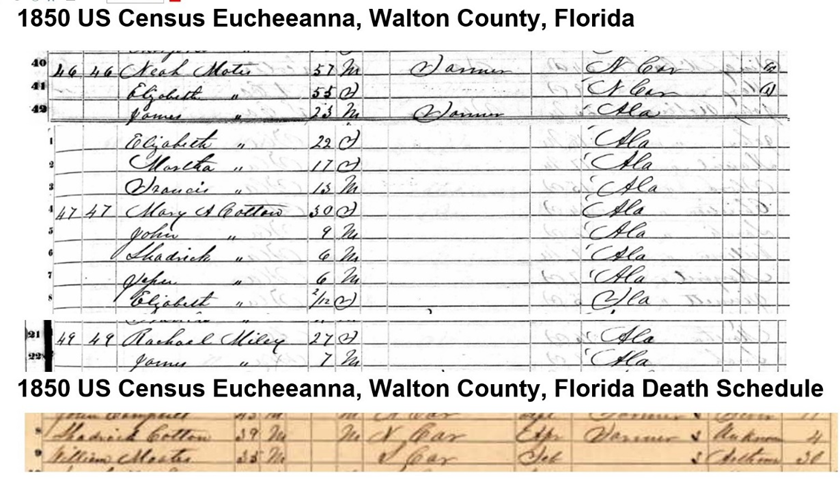
In 1850 Noah and his family appear in the US Census for Eucheeanna, Walton County, Florida. The family occupies three separate structures, namely #46, #47, and #49, their names appearing along with those of two deceased family members (son-in-law Shadrach Thad Cotton Æ 39 and son William Moates Æ 35) [note: Æ denotes “at the age of”] who perished in the previous year, respectively in April and February 1850, according to the census “Death Schedule.” The Euchee Valley entourage included Noah (Æ 57) and Elizabeth (Æ 55), two surviving sons (James Æ 23 and Francis Æ 13), four daughters (two unmarried: Elizabeth Æ 22, Martha Æ 17, and two other married daughters who were widowed or abandoned, namely: Mary A Moates Cotton (Æ 30), and Rachel Moates “Miley” (Æ 27) and five grandchildren (comprising the four Cotton children and my great grandfather James Marion “Miley” Moates (Æ 7). This is a total of thirteen (13) living individuals who resided in proximity on the family estate. Below is a composite of the enumeration of the 1850 Census where these Moates folk appear. This large contingent required a substantial farm for support.
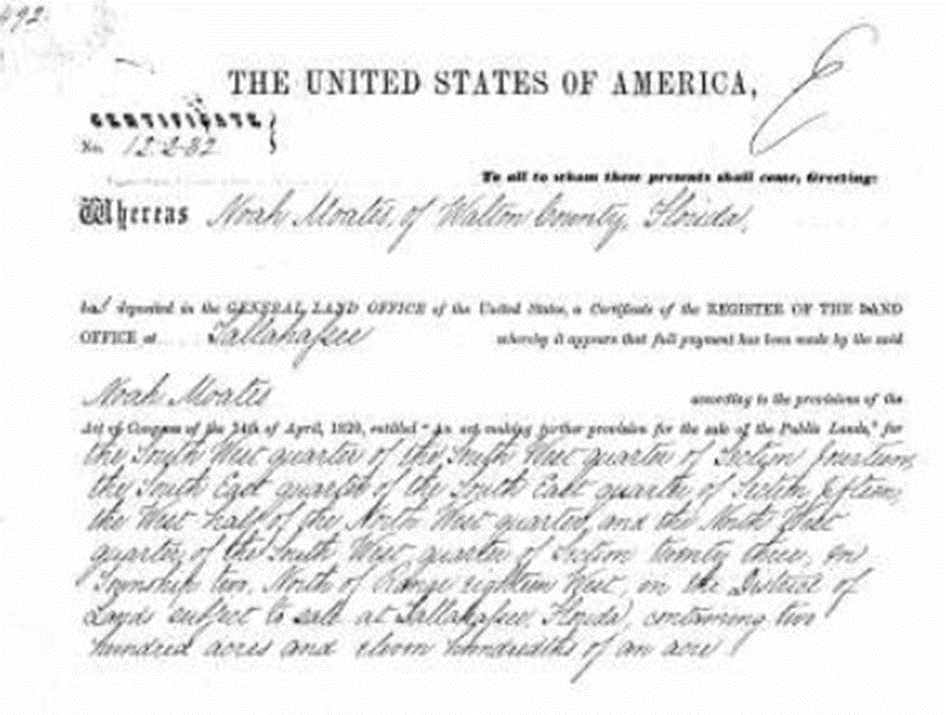
Thus, in 1850 they probably squatted on land that Noah later purchased. In 1853 Noah Moates filed for and was granted in 1857 a patent for an estate of about 200 acres in Township 2 North Range 18 West with aliquots in Sections 14, 15, but principally in 23. Below is a reproduction of part of the patent.
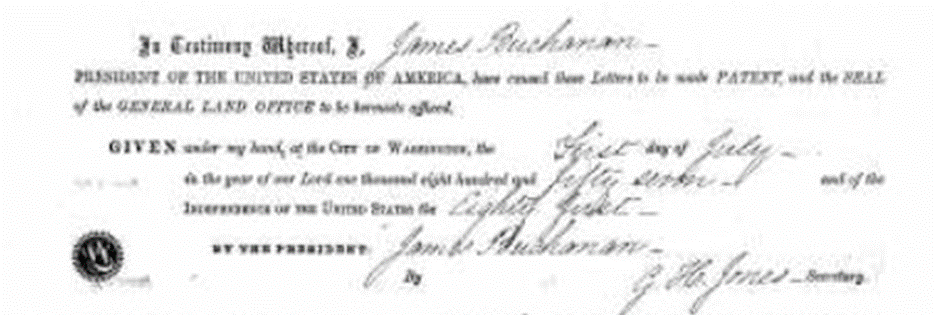
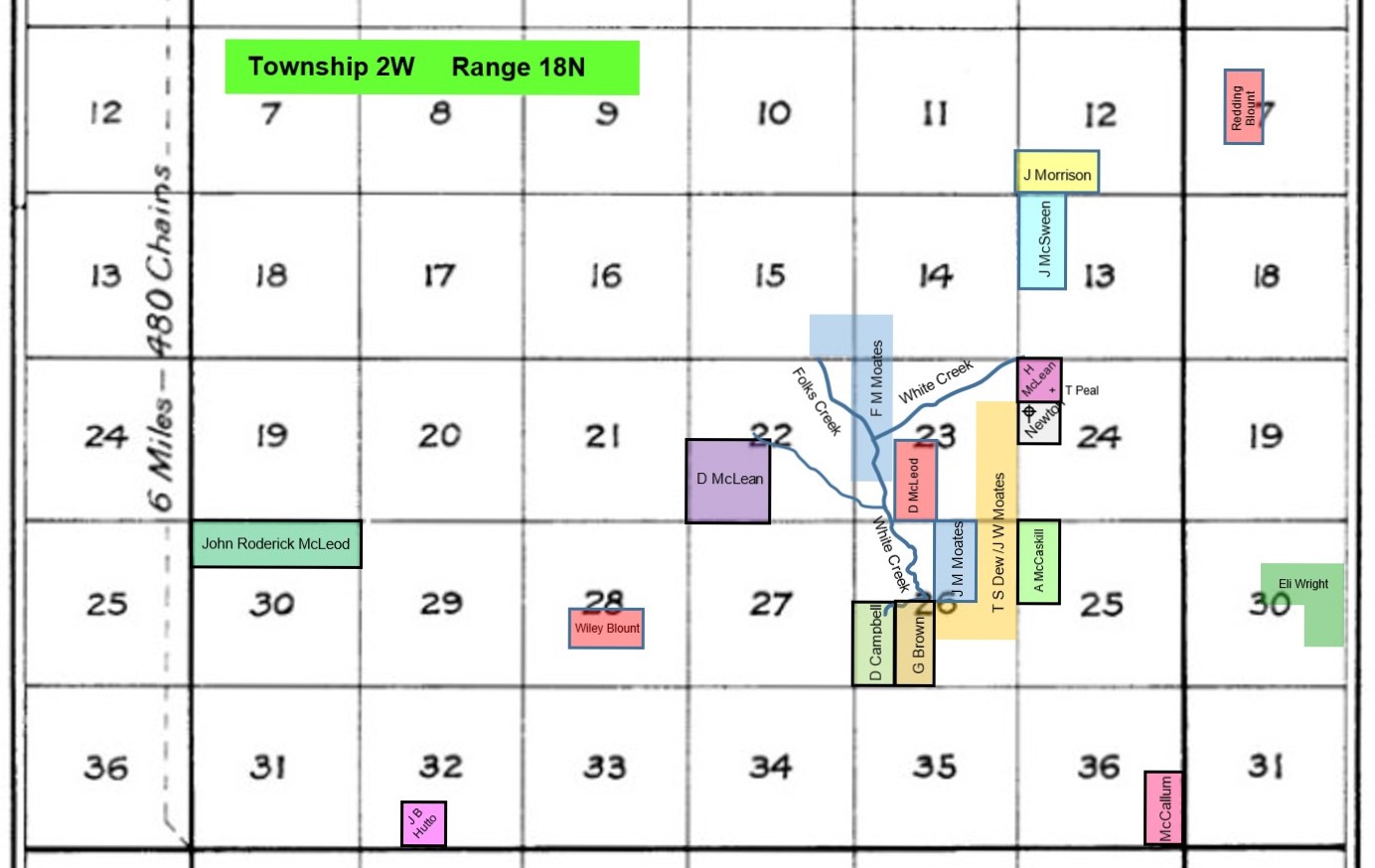
This property is located in present-day Walton County, near DeFuniak Springs. Florida. The bulk of the land is situated between George Montgomery Road and County Highway 280 E, on the north and south respectively. Two creeks (Folkes Creek and White Creek) transect the wooded property. The earliest topographic maps of the area date to the 1930s. (See figure.) We can discern a now-abandoned public (dirt) road that ran across the property (beginning near 8823 County Highway 280 E and crossing the property at 1385 George Montgomery Road) of my informants James A******* (Æ 85) and that of the current custodians George and Linda S***** [names redacted to preserve their privacy], respectively. The George Montgomery Rd property was owned from about 2000 to 2019 by Mr. and Mrs. B**** who had purchased it from the land agents Gillman, Fox and Grant. Mrs. B reports that they have no recollection of any structures extant on the property. On the other hand, Mr. A informs me that his father, Lorendel A (1911-1986) indicated the carriageway survived from “horse and buggy days.” He recounted how that the women would bring their wash down to the creek crossing to clean their clothes in the clear creek water of Folkes (or Folks) Creek. The carriageway crossed the creek at either a ford or a bridge that we estimate was located at approximately latitude and longitude (30.65491° N, -86.01999° W) and approximately 100 yards northwest (up Folkes Creek) from the confluence of Folkes and White Creek.
In the image below, we see the 1933 topographic map with an overlay of the Moates and Dew-Moates patents as well as the roads and points of interest, for example extant houses in 1935 and road/creek crossings.

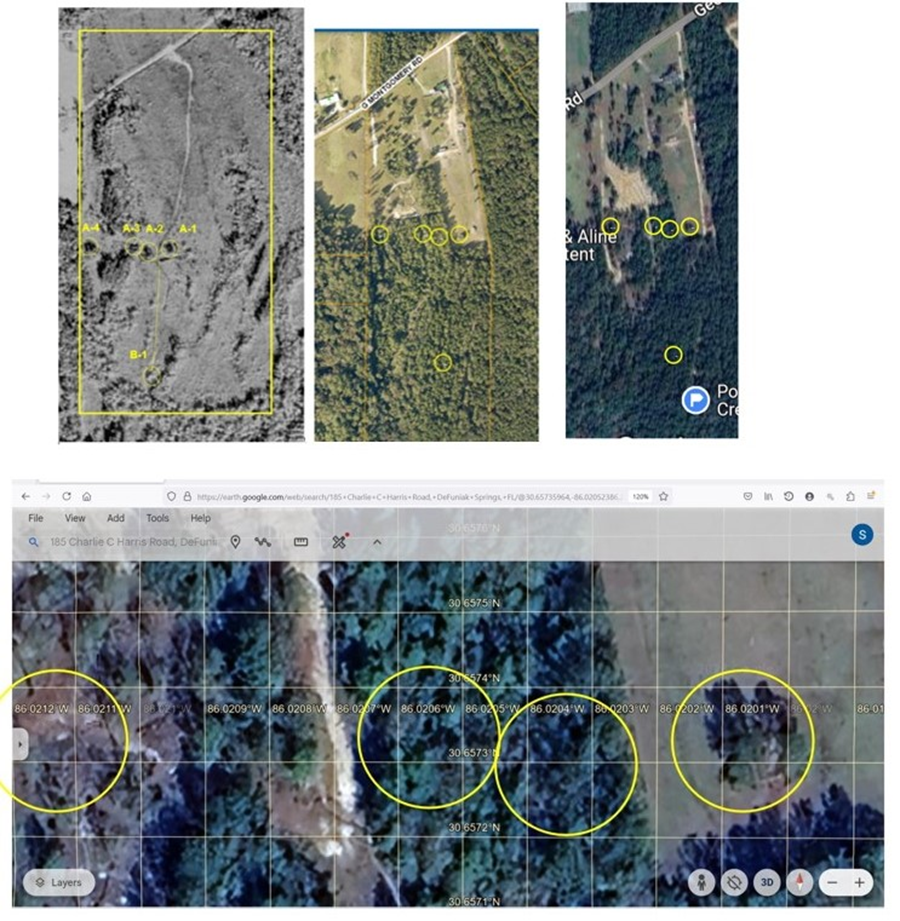
It is difficult, if not impossible, to know precisely the location of our ancestors’ dwellings, since the landscape has been remodeled repeatedly by nature and human use over the centuries. Nevertheless, we can discern traces that suggest where the structures might have been. It seems reasonable that the farm houses would have lain close to the road. Furthermore, succeeding buildings may have been constructed near or within the same footprint of the earlier structures. Below are aerial photographs from the mid-twentieth century (extreme left and right) sandwiching a recent image (in the center). Five regions of interest (ROI) are marked with yellow circles in each image where potential structures or their ruins appear. These ROI deserve further investigation to establish the “ground truth.” [Unfortunately, the current owners of the site have not, as of this writing, granted permission for us to trespass on their property.]
Envisioning The “Cracker Farm House”
While there is no discernible structure still standing from the antebellum period on the Moates Folkes Creek-White Creek Farm, there might be ruins from that period, but, nevertheless, no building survives. It is left to our imagination to reconstruct what residence the Moates family might have looked like. We have in my family photo archives three images that are a help.
Originally, in 1850 Noah Moates must have constructed simple log cabins to shelter his family. Such rude structures may have sufficed for a few years but by a decade later a more substantial farm house surely would have been built.
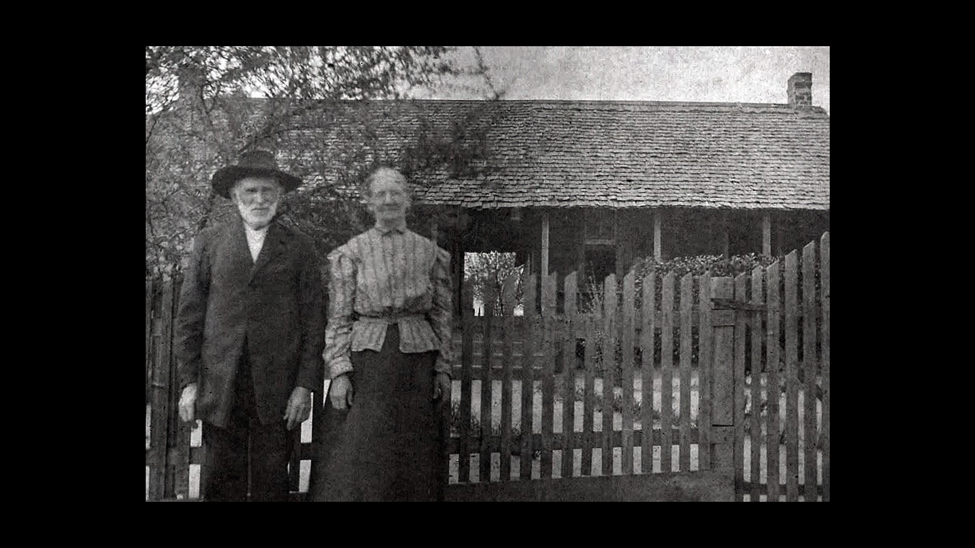
Subsequently, Patriarch Noah Moates would have built a typical “cracker” style home like that shown below owned by Malachai and Sarah Dew Murphy (she the eldest daughter of Rev. Thomas Dew), shown standing in front of their home near the turn of the 19th century in Altha, Florida. Such dwellings typically consist of two rooms under a single shingle roof with an open “dog trot” breeze way between. Each of the two “pens” would have a fireplace for warmth and cooking. The whole of the structure would be built on “pins” of stacked stone or brick.
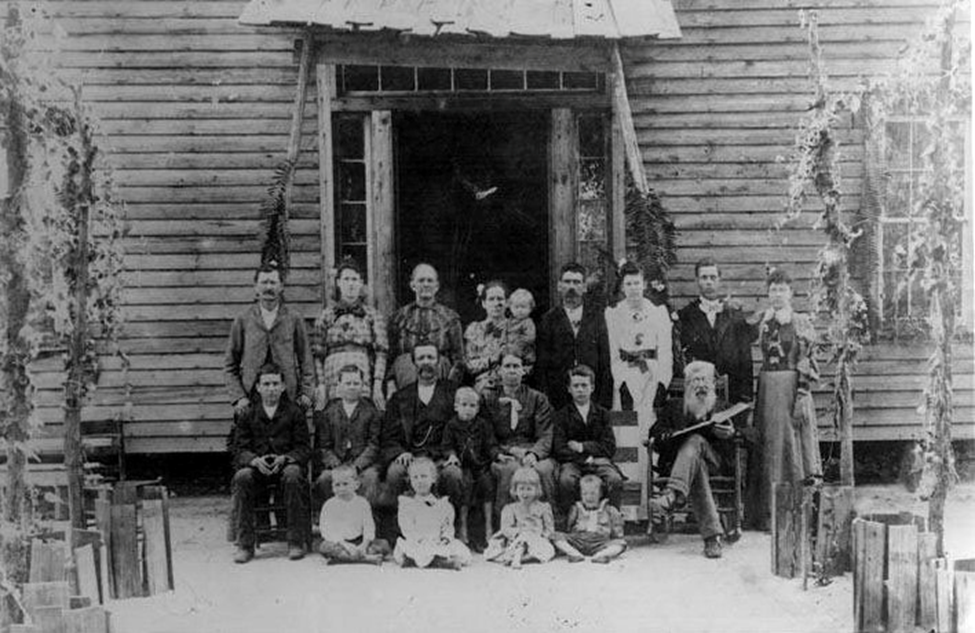
This early design persisted into the late 19th century. As illustrated by the 1894 image of the homestead of Rev. Thomas S. Dew in what became Houston County, Alabama.
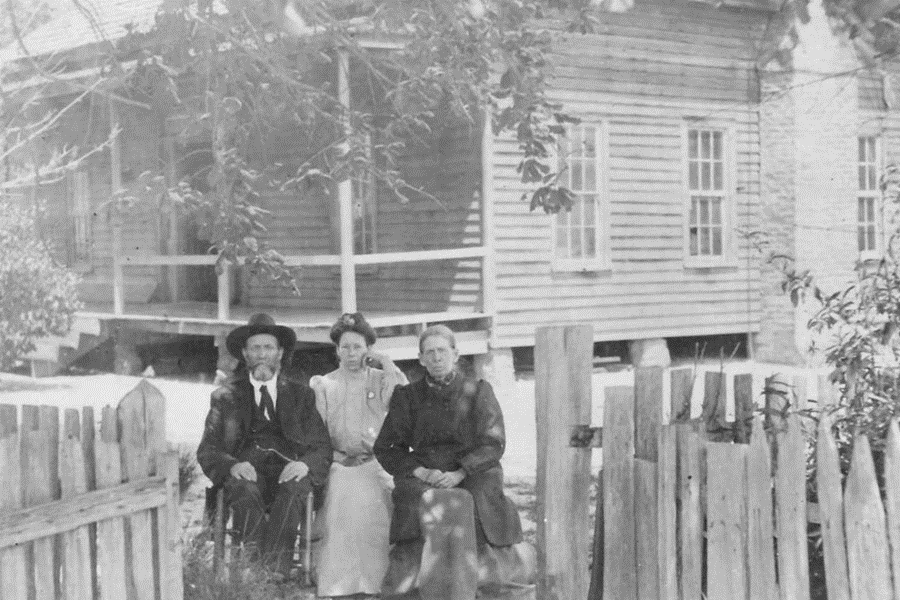
Similarly, we see the common features in the home of James Marion Moates in Dothan, Alabama in a few years later. The individuals in the photo below are James Marion Moates, and wife Ruth Ann Dew Moates, my great grandparents bookending daughter Geneva (or Genella) Moates, my mother’s Aunt.
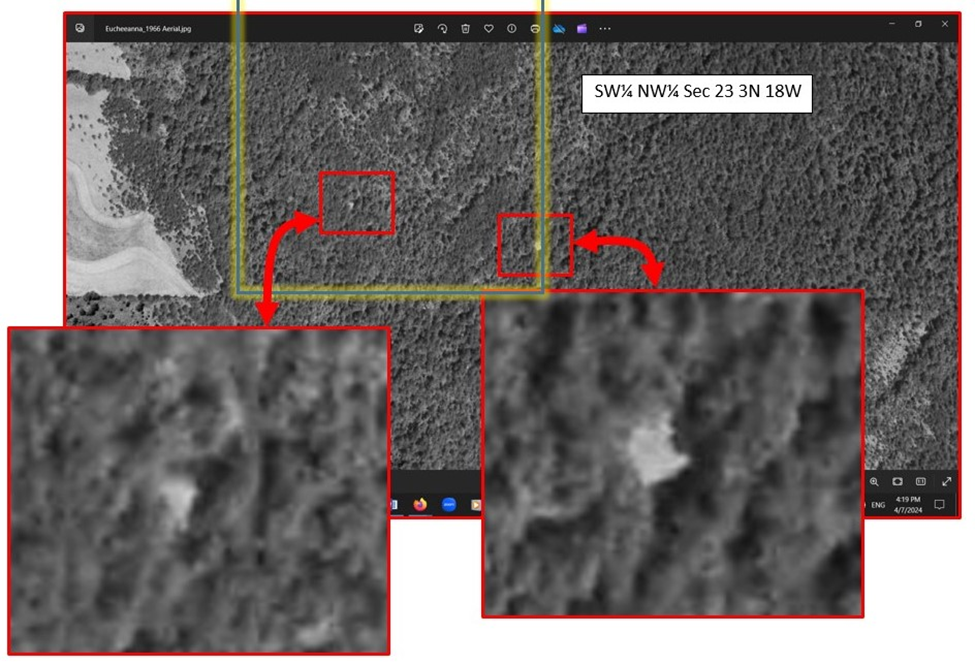
But is there any evidence of such structures on the land? A tantalizing aerial photograph from the mid-twentieth century below shows timber land had been harvested by clear cutting. It appears that there are four (or five) structures or their ruins on the acreage.
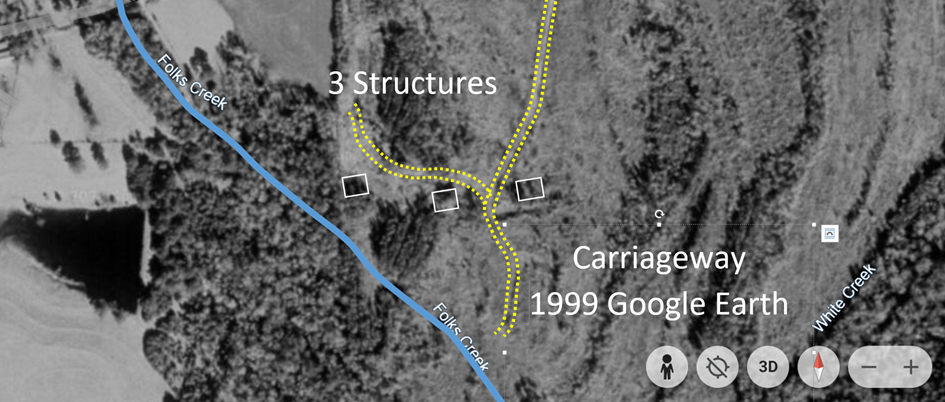
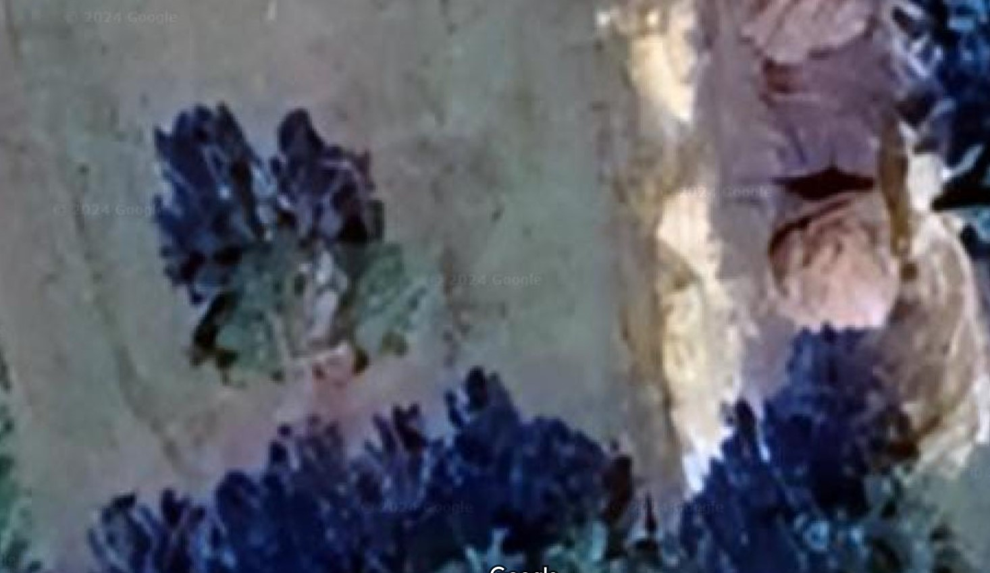
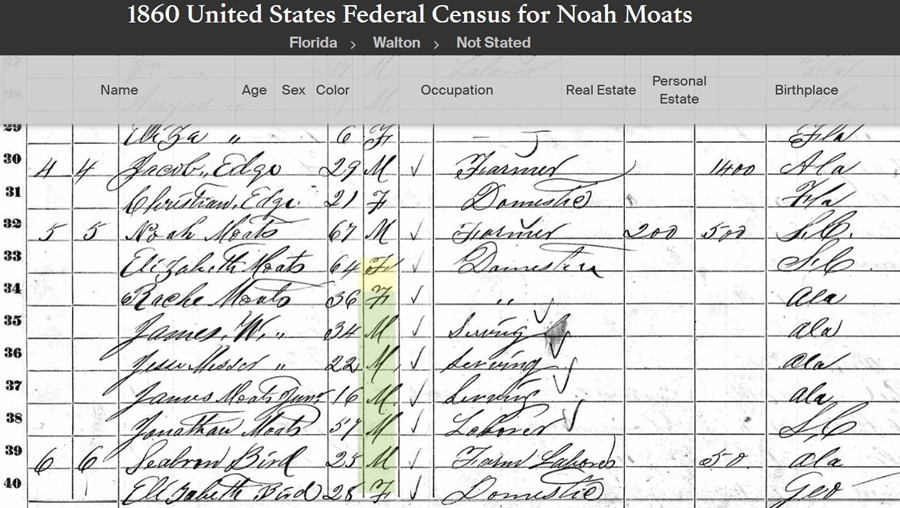
The Noah Moates Folkes Creek-White Creek family farm was occupied in 1860 with many of the same people who had immigrated to the Euchee Valley a decade before. This image suggests the possible existence of the ruins of historic dwellings. But without actual close examination in person the “ground truth” must elude us. What is clear is that the Noah Moates family immigrated to this farm (The Folkes Creek-White Creek Farm) in about 1850 and resided there for over twenty years. In 1860, on the cusp of the Civil War, the Moates clan on the farm consisted of Grandpa and Ma Noah and Elizabeth, daughter Rache[l] Son James W, nephew Jesse, Rachel’s son James Moates “Junior,” and Noah’s recently divorced brother Jonathan (Jesse’s father). Son Francis Marion Moates lived elsewhere in the county a mile or two away with his new bride, Polly Peel Moates.
The War Years and Postbellum
By 1864, Jonathan was deceased, dying in the military hospital at Chattanooga. Not long afterwards Noah succumb, as well and was—we suspect—laid to rest in a poorly marked grave in the cemetery adjacent to the Euchee Valley Presbyterian Church. (See https://sammatteson.com/2024/12/ ) Grandma Moates and her daughter Rachel and her sisters persevered alone without the men folk, even enduring a Union raid in September of 1864. It must have been a desperate time afterward since all the available food and livestock had been confiscated by the marauding Yankees.
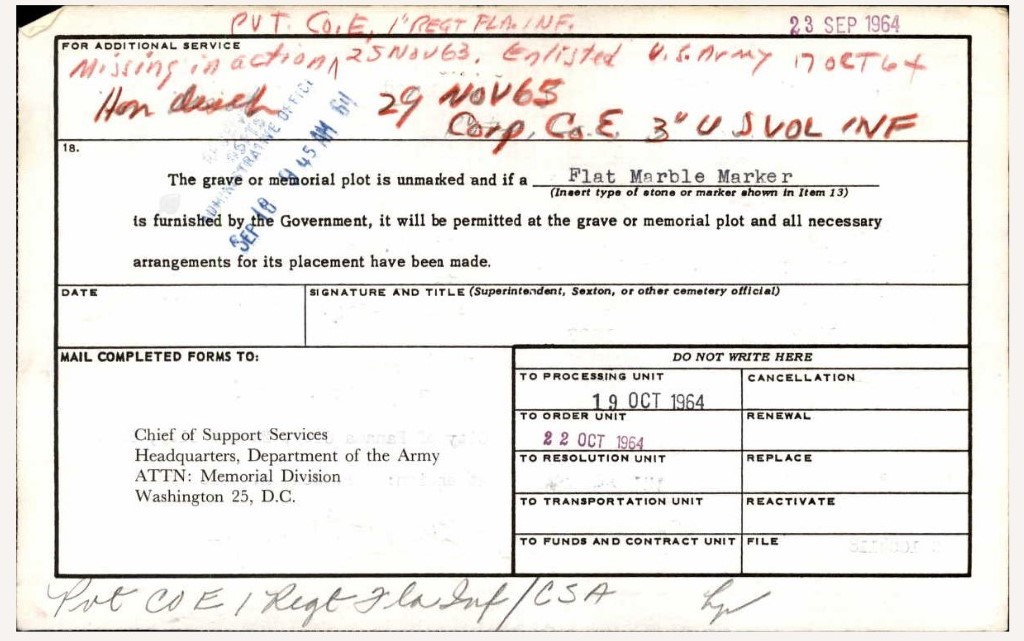
Following the end of hostilities, the brothers James W., Francis Marion, and their nephew James Marion Moates returned to the Euchee Valley patrimony. Francis returned to the waiting arms of his wife, Mary Ann “Polly” Peel (born in Burke County, Georgia niece to Thomas’ wife Aunt Elizabeth Atkinson Dew, her mother’s sister). Francis had wed Polly in 1859 before enlisting, before fighting in Tennessee, before enduring capture and imprisonment, and before securing a pardon to serve in the union army fighting Indians in the Nebraska Territory. Soon after the war Sgt. James W. married neighbor Flora Ann Campbell on 11 Oct 1866; while Pvt. James Marion, my ancestor, married Rev Thomas Dew’s daughter, Ruth Ann Dew, the girl next door, on 7 Feb 1867. In the 1870 census we find Francis and Polly living on the Folkes/White Creek farm, with James W. and Flora residing a mile east on the plantation owned by Rev. Thomas Dew, who was recently widowed and who had removed with his last surviving unmarried daughter Mary Ann Dew to Hickory Hill (also known as Orange Hill) in Washington County to pastor the Union Baptist Church. James W. and wife Flora, who would soon purchase the property in 1875, we find in the 1870 census living with their son Noah Daniel Moates and mother Elizabeth Moates (Æ 73). Nearby Section 23, his nephew James Marion Moates oversaw a household that included his young bride Ruth (Dew) and his mother Rachel (recently widowed by the Mr. Gleason). Circumstantial evidence suggests that not long before the census, Ruth had given birth to a daughter Martha Ann Moates, who survived less than a year. Martha apparently had been named for her aunt Martha Ann Dew (Rev Dew’s daughter and Ruth Dew Moates’ sister) who was recently deceased. Theirs was a family of sorrows and acquainted with grief.
Thus, the Moates and Dew clans, as well as the Moates and Campbell families, were joined in marriage in multiple liaisons. Where one lived strongly influenced whom one married. The Moates, Dew, Pell, and Campbell family farms all clustered about Section 23. Proximity led to affection; affection to marriage; marriage to family and thus, to us. In at least this subtle way, the “where” influenced the who of us and all our ancestors’ descendants.
By about 1880, much of the older generation was gone: both Noah and Elizabeth Moates and their daughter Rachel were deceased, as was Elizabeth Dew. Only Rev. Dew from among my 2x great grandparents survived; he had, however, also moved on to Washington County where he was joined by two of his daughters—Mary Ann and Ruth Ann with her husband, the Reverend’s son-in-law James Marion Moates. The part of the Moates family that remained in the Euchee Valley after the mid-1870s were the families of Francis Marion and James W. Moates and daughters Mrss. Cotton, Hutto, and Lassiter.
The Suspected Moates Mill
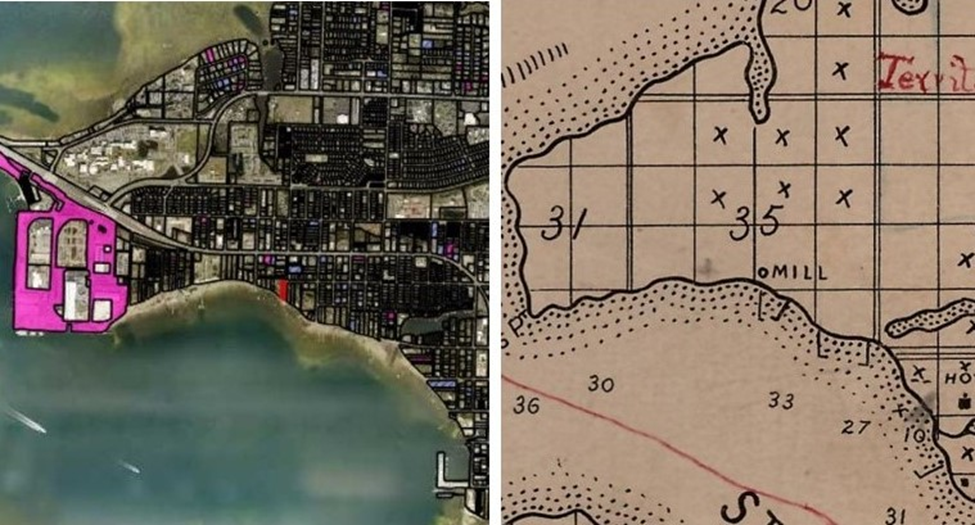
As the decades after the Civil War rolled on, the veterans attempted to regain their financial footing. I am persuaded that the brothers Moates operated a steam saw mill/grist mill on the Moates family farm. The source of this notion is the proximity of a millwright (Solomon Sikes) living next door to Francis in 1870 on the Folkes/White Creek farm. In the same census James’ occupation is listed as “miller.” Moreover, Francis later, after he immigrated to St. Andrews in Washington County in about 1890 until his death, operated a saw mill on the banks of St Andrews Bay. In aerial photographs from the early twentieth century we observe traces in the image of sawdust piles near where the carriageway crossed Folkes Creek. The prospect of Reconstruction-era relics of the mill lying buried in the sand on the banks of the creek is tantalizing. However, only a thorough survey, perhaps using a metal detector can confirm the conjecture. We can get an idea of the nature of the putative mill by examination of contemporary mills. Francis built a sawmill on the backbay of St. Andrews Bay that appeared on a Sanborn Fire Insurance map.
By 1890, the hypothetical Moates Brothers Mill must have ceased operation. We can confidently assert this as fact since the property was in the possession of a neighbor by then; it was sold to Mr. and Mrs. Lowe, who later sold it to William Crawford in 1885. Most real estate documents from before 1885 were lost in a courthouse fire that year. We can imagine what the mill might have looked like from a photo of a mill on Wrights Creek near Caryville, Washington County that is associated with Seymore B. Sikes the two-year-old child of the millwright neighbor of Francis Moates. (See Photo)
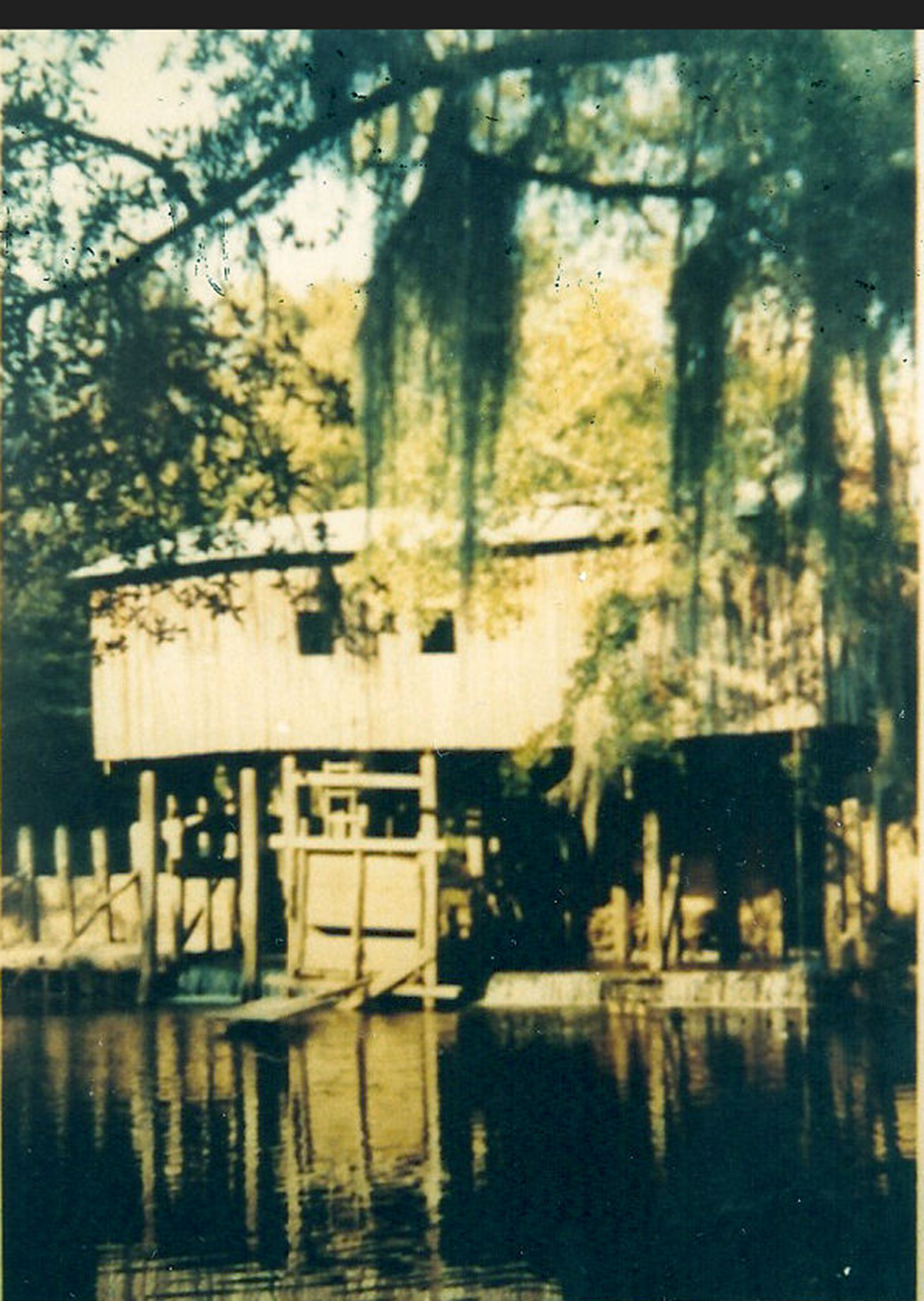

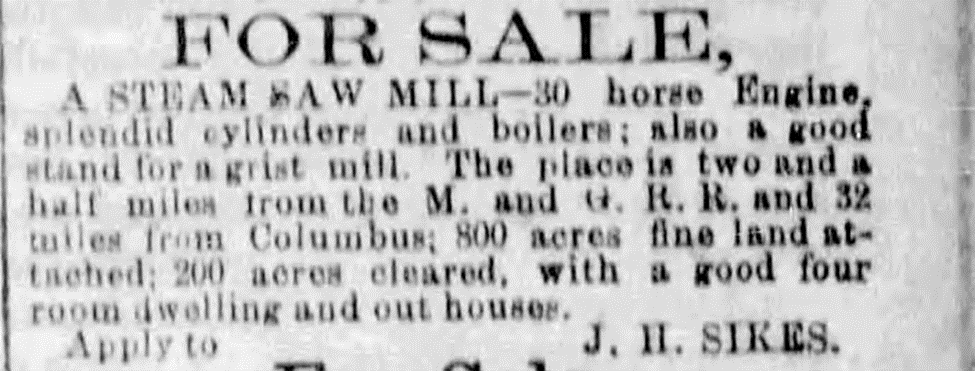
Typical of such is a structure built on pilings over the waters’ edge, often with a sled ramp for hauling logs up to the saw head. Often the mill is little more than an open shed to protect the steam engine and saw head from the weather. A grist mill typically was enclosed to preserve the cleanliness of the meal. We should look critically for any trace of the foundation of such a mill or discarded parts of the mill machinery to establish the mill site. I have included an advertisement for a used combination stem saw and grist mill to suggest the commonality of such technology.
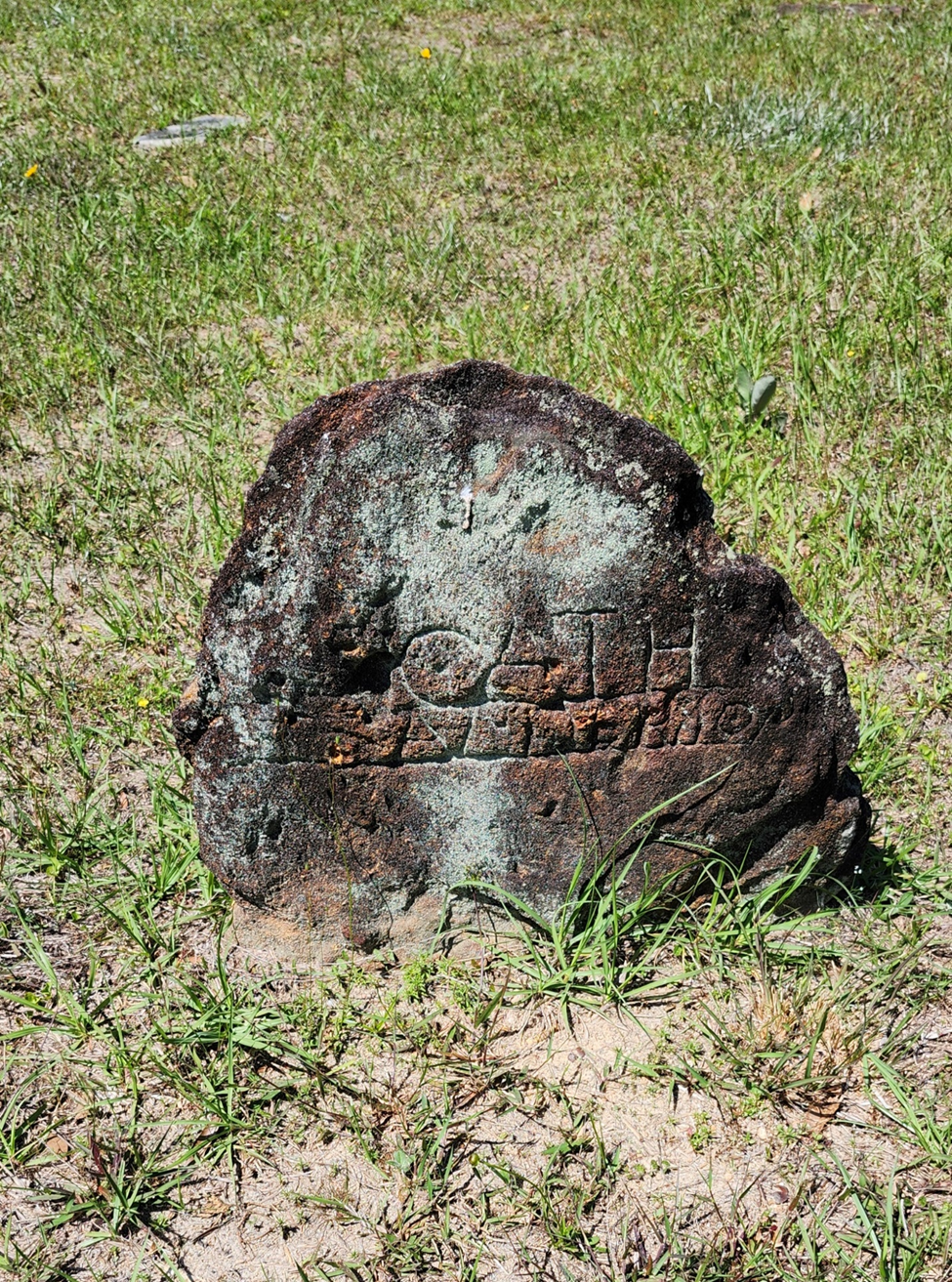
By about 1880 Francis Marion and James Marion had quit the county and joined Rev Dew in Washington County, Florida. Francis ultimately was a pioneer and entrepreneur of St. Andrews. Meanwhile, James W and wife Flora sold their interest in the Dew-Moates farm and moved a few miles north to a farm in Argyle. The tombstones of Noah and Elizabeth Moats/Moates of red sandstone began to disintegrate in the Euchee Valley Cemetery. The name “Moates” was lost to the communal memory. An echo of their name, albeit distorted, appears in the History of Walton County by John L. McKinnon (1911 Byrd, Atlanta, Ga). On page 42 we find in the list of the pioneer families the name “Oates.” This family name does not appear in any census before the twentieth century and is likely a corruption of the name “Moates.” The figure below is a composite of the title page and page 42 with the family Moates highlighted.
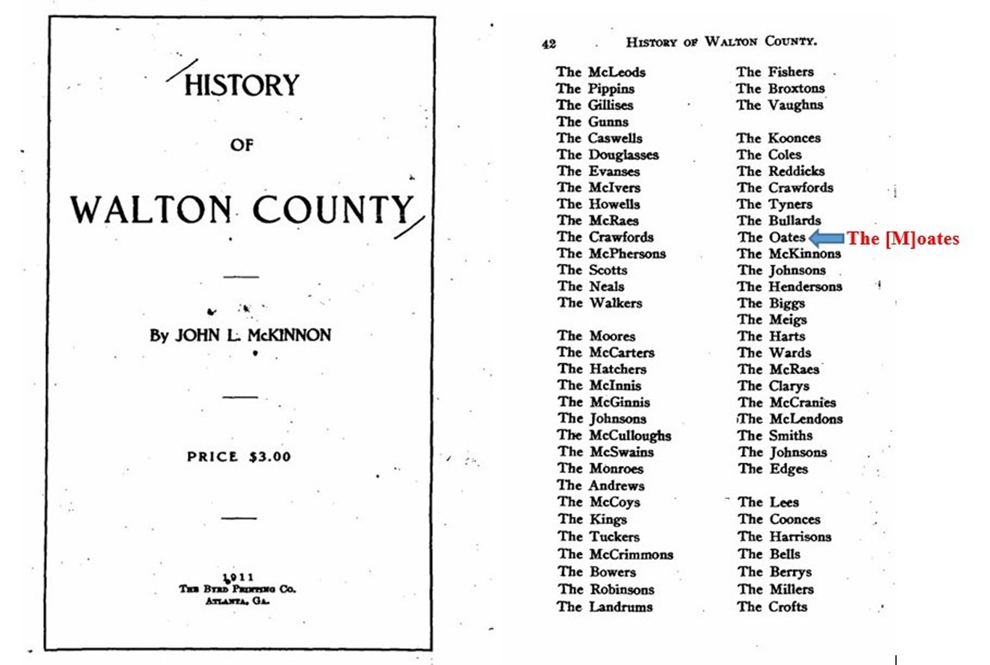
The error may have arisen because by the turn of the century the Moates clan had moved on from the Euchee Valley and the only record of their presence was the poorly marked graves of Noah and Elizabeth Moates in the Euchee Valley Cemetery. It would be a tragedy for all vestige of our family’s long residence in this place to be erased and forgotten. They were here; they persevered; they mattered. I resolve that though they are gone, they will not be forgotten in this place. All that remains of Harriet Elizabeth Moates tombstone is [M]oat H.
The Significance of Where
Thus, we can confirm that Township 2 North Range 18 West, Section 23, Walton County, Florida was the nexus of our Moates-Dew family’s activities from about 1850 to 1885. Although in later years, they relocated to southeastern Alabama and other counties in Florida, here the Euchee Valley cradled my great grandparents’ development that shaped us in the centuries to come. And in each generation afterward we inherited—knowingly or unknowingly—a legacy of sandy soil between our toes washed clean in the clear spring-fed creek water of our patrimony.




 Sam Matteson