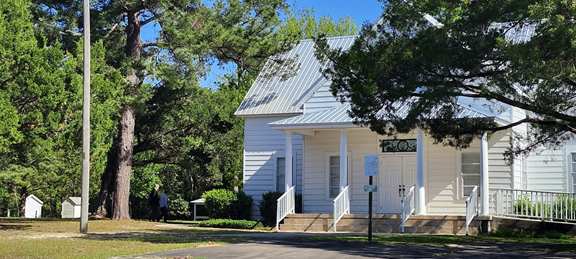
Probably a Genealogist
“Probably a genealogist,” Mrs. Bailey remarked to her husband when they saw me photographing tombstones in the Euchee Valley Cemetery that Sunday afternoon in April 2024. They had come to visit the graves of his departed aunt and uncle when we greeted each other. I explained that I was looking for the final resting place of my ancestors, the Dews and the Moates family who had lived in the 1800s at the now vanished community of Eucheeanna, Walton County, Florida.
After a diligence search, I think that I at last have found the lost tombs. The difficulty arises, unfortunately, from the fact that only one legible grave stone remains today, that of my great-grand aunt Mary Ann Dew Sowell, listed on the cemetery catalog as plot #646. It seems, at first, to be a puzzle why she was buried here when much of her family lies in Dothan, Alabama, the city of residence of her and much of the Dew family after about 1890. The answer, I suspect, is the key to the identity of her companions in repose in the cemetery that lies outside of De Funiak Springs, Florida. The on-line numbering of the plots was helpful in finding the area of the relatively large cemetery. By “triangulating” from various surviving tombstones we were able to pinpoint the plots of interest. In fact, I doubt I would have found her grave without it. The area where Aunt Mary is (and much of the rest of her family probably are interred) appears below in the aerial photograph of the of the area graveyard lying within the white circle about fifty feet north of the service road and east of the row labelled “I. “

Mary Ann Dew Sowell, Rev. Dew’s Daughter
I found Mary Ann Dew Sowell’s grave after an arduous search. Entering through the service gate south of the white frame building of the Euchee Valley Presbyterian Church (see the aerial above and the photo below) I proceeded about half-way back toward the rear eastern side of the sacred grounds. Looking left, we can see a distinctive cross-shaped marker of the Irvine plot. This became a prominent landmark for finding the plots.

The cemetery is hard by the venerable Euchee Valley Presbyterian Church (featured image above) that was founded in 1827. Incidentally, Rev. Samuel D. Campbell of Virginia purchased a large tract of land across the road (currently County Highway 183 S) while he briefly served the church as pastor. After he had moved back to Virginia, his interest in the property on the frontier waned. Subsequently, in December 1859, he sold the 279 & 79/100 acre property to my 2x great grandfather, the Baptist Preacher Rev. Thomas Spenser Dew, Mary’s father for $450. A little over fifteen years later (17 April 1875) he would deed the tract to my 2x great uncle James W. Moates for the sum of $600, who farmed it until the later 1890s. Uncle James was the namesake of his nephew and my great grandfather, James Marion Moates. Apparently Uncle Jim had been living on the land, farming it, and working as a miller in collaboration with his brother Francis Marion Moates (for whom my mother’s grandfather was also named) since about 1870 when Rev. Dew had moved to Washington County to pastor the Union Baptist Church in Orange Hill. (See previous post).

The Mystery of Neighboring Unmarked Graves
In the 1860 census Rev Dew appears with his four daughters and wife Elizabeth with a single unnamed enslaved man servant, aged 19, who had been with the family since at least 1850 when they lived in Ozark, Alabama. But by 1870 Rev. Dew was widowed and had moved to Washington County, forty miles east. He was accompanied by his youngest daughter Mary Ann, who found a husband in Ransom Sowell in the Orange Hill Community. Meanwhile, her sisters, the war widow Sarah Ann Dew McSween was living in Holmes County with her children and mother-in-law, and Ruth Ann Dew Moates (my great grandmother) who lived with her husband James Marion and mother-in-law Rachel Moates Miley Gleason on a farm adjacent to the Campbell-Dew-Moates property in a community later was known as “Campbelltown.” In subsequent decades Sarah Ann married Elder Malachi Murphy and moved to Altha, Calhoun County, Florida, while Ruth Ann moved to Orange Hill and subsequently to Dothan, Alabama where they lived out the remainder of their lives and where they are buried.
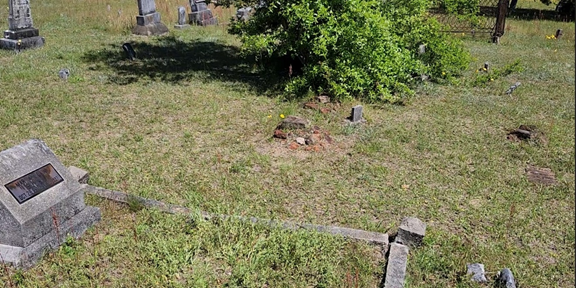
An examination of the layout of the plots adjacent to Mary’s resting place suggests the potential identity of the interred. Immediately to the north of Mary’s grave is an unidentified grave marked with nineteenth century era fired bricks. I suspect that this is the grave of Elizabeth Atkinson Dew, Mary’s mother. This idea is very plausible and persuasive. The next plot contains the unidentified grave of a child, marked with both similar bricks and a small granite, lichen-covered standing slab. I believe this is the final resting place of little Martha Ann Moates, the daughter of James and Ruth Ann Moates, who died on 24 March 1870 according to a family Bible entry. At about the same time (before Dec 1869) her Aunt Martha Ann Dew (and her namesake) disappeared from the public records, presumably dying before 1870. In the photograph below we see an overhead view of the three graves.
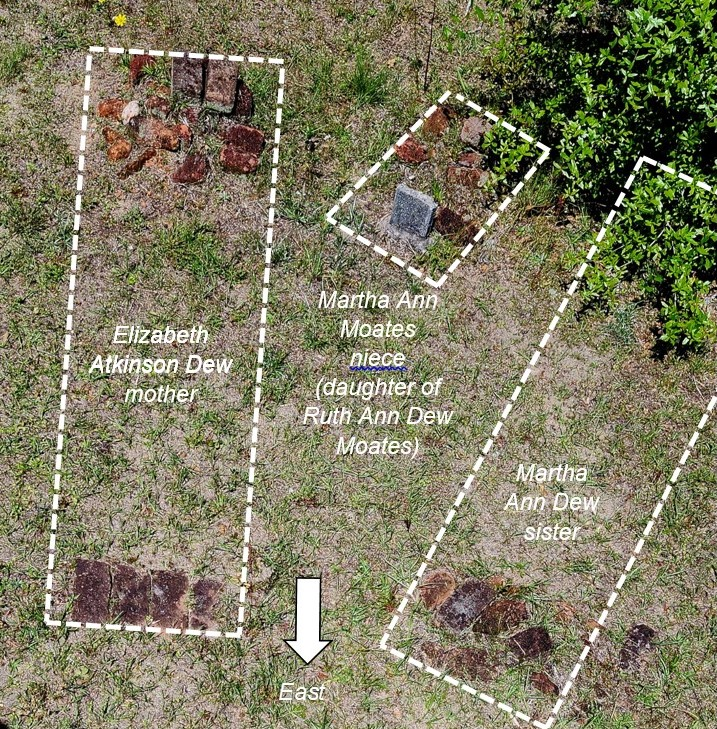
The graves are clustered around a crepe myrtle tree, a traditional symbol of mourning and memorial. Other grave sites nestled in among the trunks of the flowering tree may be that of Martha Ann Moates’ other grandmother Rachel Moates Miley Gleason, who we infer died about 1872. Two other more speculative assignments are that of Noah Moates’ brother Jonathan Moates who died in the Confederate Army hospital in Georgia and whose corpse was claimed by his brother in 1863, and that of William Moates, Patriarch Noah’s son. who died shortly after the Moates family moved to the Euchee Valley in about 1849. The evidence for these conjectures is their proximity to each other, as well as the similarity in the marker: a simple granite slab. The extensive lichen overgrowth on the stones might be obscuring an engraving, although the growth may have eroded, over the century and a half, since its inscription. Clearly, these graves date from the 19th century—with the exception of Mary Ann’s final resting place. At the end of the century all of the surviving Moates-Dew family had relocated farther east in Florida and north into the wire grass region of Alabama where my mother’s people resided and she was reared.
The Moates Matriarch and Patriarch Elizabeth Harriet and Noah Moates
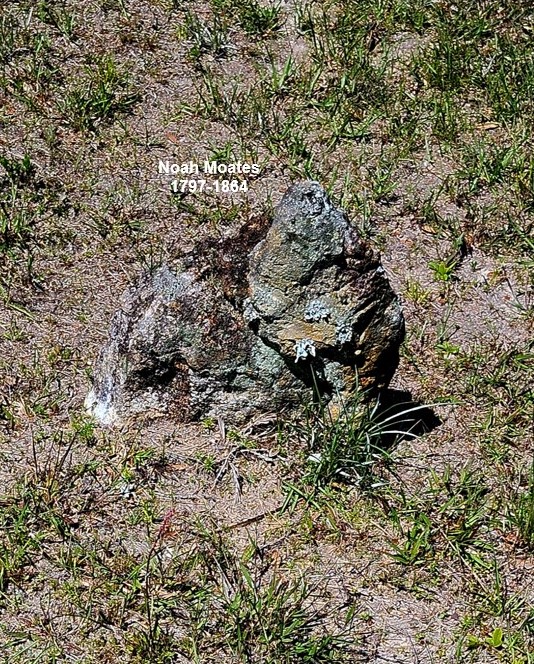
I had come to Walton County in hope of finding the graves of the patriarchs Noah and Elizabeth Harriet Pilcher Moates on the family farm a mile down the road. I found no evidence of a family graveyard on the White Creek Farm. I was pleased later to find the potential graves of their family as I have described. Then observing the graves that surrounded those that we have encountered above, I chanced upon two red sandstone markers. One was completely degrade but the one on the left (facing eastward) bore a partial inscription that froze me in mid-step. The sun was at just the right elevation to cause the surviving engraving to stand out in high contrast. I discerned the letters [ ] OAT H. Could this be the tombstone of Elizabeth Harriet Moat/Moates? I am persuaded that, indeed, this is the case. In the photograph I have superimposed my probably reconstruction of the inscription on the image of the stone. The “O” with its idiosyncratic central dot is unmistakable. The date of death appears to be Aug 1870 (a date unquestionably ending in zero). This correlates well with Dame Moates appearance (as “Elizabeth Wilhout age 73” as we explored in an earlier blog) in the 1870 census taken the 25th Day of August that year. On her right—the traditional position of the male spouse—is a much degraded sandstone monument that I infer marks the grave of Noah Moates, my 3x great grandfather, who perished on 2 Feb 1864 according to unconfirmed genealogical information that I found on ancestry.com.

Gone But Not Forgotten
Thus, I came away from the cemetery that day with a partial sense of satisfaction that I had located—with as much certainty as is common in such matters—the final resting place of several of my forebears. We may ask, “What difference does it make?” In reply, I declare that their final resting place helps us remember them and recall their story. And as the frequent epitaph declares they are “Gone but not forgotten.”
Indeed, we will remember them and say their names. I once heard Mandy Patinkin, distinguished actor, remark during an interview with Dr. Henry Louis Gates, Jr. that while he was performing the musical Carousel Oscar Hammerstein encouraged him saying “As long as there is one person on earth who remembers you, it is not over.” I see it as my job as a genealogist and historian to remember and help you remember. It is therefore “Not Over.”
 Sam Matteson