In 1869—not long after his beloved wife of over 30 years, Elizabeth Atkinson Dew had died—Rev. Thomas Spenser Dew left his farm and ministry in Eucheeanna in Walton County, Florida that was situated across the road from the Euchee Valley Presbyterian Church to move to the community of Orange Hill, Washington County, formerly known as “Hickory Hill.”

In the US Census of Aug 1870, James W. Moates (mis-transcribed as James “Wilhout”) resided with wife Flora, widowed mother Elizabeth, and son Daniel Noah, on the Dew-Campbell property that Rev Dew ultimately sold to him in 1875. In the months before his relocation, grief descended upon the Dew household: Martha Ann, one of his four daughters, also died and was laid to rest near her mother in Euchee Valley Cemetery. In just a few months, Martha Ann Moates, his granddaughter (the child of my great grandparents James Marion Moates and Ruth Ann Dew Moates) joined them. Daughter Mary Ann Dew, at age 20 in 1870, kept house for the Reverend, while daughter Ruth Ann Dew Moates with husband James Marion and Mother-in-law Rachel Moates Gleason remained in Eucheeanna on a holding adjacent to the Dew-Campbell farm. Meanwhile, daughter Sarah Ann Dew McSween—widow of Robert McSween who was killed in action in Mississippi—lived in Holmes County with her two girls and Mother-in-law.

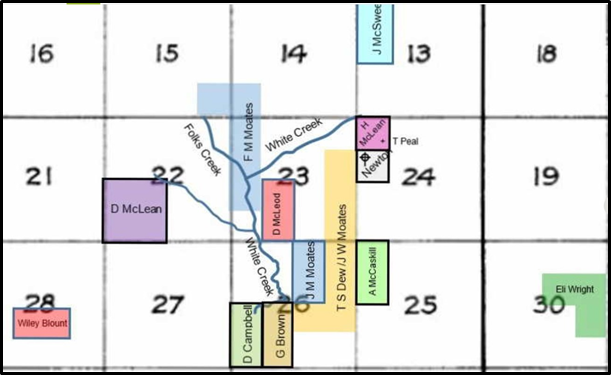
Section 23 and adjacent aliquots of land passed into the possession of several Moates Family members. In fact, family history recounts how the gentle rise in the landscape the buggy driver encountered as he approached the cemetery from the town center to the west was informally called “Moates’ Hill.” Below is a schematic of the property patents in the early post-war days.
Thus, in 1869 Pastor Dew moved 30 miles farther east, less than a decade after he had come from Ozark, Alabama to the Euchee Valley with his wife, four daughters and an enslaved man servant to assist the church planter Rev. Lester R. Sims in evangelizing and serving the sinners and saints of western Florida in the Euchee Valley. The congregation he came east to lead in Washington County was called “Union Baptist Church.” Such a designation suggests that the church shared space with another church, such as the Methodists. This arrangement was common on the frontier. He appears in the minutes of the West Florida Baptist Association for that year as its pastor, while we can infer from a note that the congregation of the Orange Hill Baptist Church had dissolved. (See image) Subsequently, in later WFBA minutes Rev. Dew appears as pastor of the (reconstituted) Orange Hill Baptist Church.

Both in the oral history of the Orange Hill Baptist Church documented by WPA historians in 1936 and in the church history of the Orange Hill United Methodist Church (OHUMC) we find that the first church house was a log structure located south of the Orange Hill Academy. The Academy was held in high esteem as the first Baptist-supported educational institution founded in Florida. The Baptist congregation met in the Academy building but later moved into the log structure shared by the two congregations, the Baptists and the Methodists—at least until it burned to the ground. Following the conflagration, the Baptists relocated farther south off the hill while the Methodists rebuilt the church on the same spot. The reconstructed (Methodist) church house is shown in the photo. (The photo was obtained from the archives of OHUMC.) Ultimately, the Methodist congregation built a modern church house on the site of the defunct Academy. (See photo.)

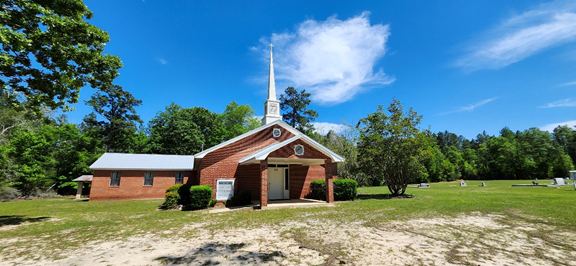
On 14 April 2024, I visited the site of Orange Hill United Methodist Church on Sunday Road, south of Chipley, Florida. Based on information gleaned from early aerial photographs of the summit of Orange Hill, I drove to the Orange Hill Cemetery on Sunday Rd and began my archaeological survey. I explored the fields across the road from the cemetery and came upon a relic of the old church house. In aerial photographs from the mid-twentieth century the original church house site is clearly visible. I stumbled upon the chiseled stone steps that led to the sanctuary.


While I was examining the remnant of the meeting house I glanced down to find a solitary charred piece of wood lying on the surface of the space that lay under the razed and removed clapboard church. Could this be a relic from the original log cabin? It is a definite possibility. I stepped to a place a few yards opposite the entrance and recalled my Great-great grandfather Rev Thomas Spencer Dew, who may have stood in that spot about 150 years before (1869-74) and proclaimed the gospel to the good people of Orange Hill.

Moates-Dew Family oral history reports that the Reverend was a prophetic and powerful preacher who proclaimed the gospel until the year he died at age 89. As I clutched that charred wood in my hand, I felt a renewed connection to and appreciation of my long-departed ancestor on that Sunday afternoon that transcended dry DNA data and genealogical analysis.
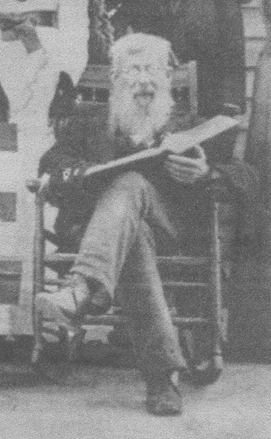
 Sam Matteson