Every once in a while, when researching family genealogy and personal history, I come across an incident that is so compelling that it breaks my heart. When this happens the history of my ancestors and of their struggles coalesce in my consciousness and their story demands telling. Such is the case in the family of Francis Marion and Mary Peel Moates, my great grandfather’s uncle and aunt. The tragedy they experienced centered on the sinking of the Sloop Amelia.
The Family of Francis Marion Moates and Mary Rebecca Peel
I first met Francis in my inquiries when he appeared as a young man, the uncle of my great grandfather James Marion Moates; since he was only six years older than Francis M. he was more like an elder brother than uncle. For him James Marion Moates was named, in part. Uncle Frank (as I shall call him) was born in land-locked Pike County, Alabama probably near Briar Hill and probably in the very house where Grandpa Jim first opened his eyes six years later.) Frank and Jim served together in the same unit of the Florida Infantry (CSA) during the Civil War. At Chattanooga, however, their paths separated: Frank was captured at the Battle of Missionary Ridge, while Jim was injured but eluded the Blue Coats.

Frank had married Mary Rebecca Peel in Euchee Anna, Florida in 1859 before enlisting. Together they had ten children by 1886 when Mary ended her child bearing years at age 44.
The F. M/ Moates family made their home in northwest Florida, first near present day DeFuniak Springs where Noah Moates had settled in 1850, then near other family in Orange Hill, Washington County just down the road from Jim and his growing family. But ultimately—as we learn from Mary’s obituary (Panama City Pilot 15 Nov 1928 p 6)—in February 1879 the couple and their seven children, who had been born by then, moved to the shores of St. Andrews Bay near present day Panama City, Florida. They purchased a half section and built what is reported to be the first sawmill in the county following the war. Below is a montage of present day West Bay with its million-dollar lots and an 1888 map showing the Moates Mill in Section 35 Township 3S Range 15W. The red highlighted lot on the left marks the approximate location of the mill today where no trace of the historic structure remains, erased by progress.

It is no wonder that after a decade of living beside the Gulf, two of the Moates girls married mariners. The eldest daughter Mary Francis Moates (born 1863 in Eucheeanna) married William Stephens, a commercial fisherman, while Elizabeth Carrie Moates (born in 1874, five years before the move to St. Andrews) married a Greek immigrant, John Constantine. Captain John piloted a freighting sloop, the Amelia back and forth across the Gulf of Mexico visiting ports from New Orleans to Tampa.
A Fateful Excursion
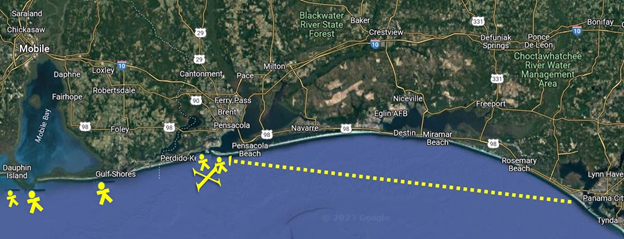
So it was that one Sunday, 29 March 1897, a party of nine souls embarked from St. Andrews Bay bound for Pensacola, about hundred and thirty nautical miles away. On board where Captain John Constantine, his wife Carrie Moates Constantine, their three young children (sons Nicky age 3, Tony C age 6 months, and an as-yet-unidentified child), Mary Moates Stephens and her daughter “Nettie” about sixteen, the Moates sisters’ brother Ben Moates (25), and a young Greek man variously identified as “Moses” or “Christopher Samiota” (probably actually Samiotes). The newspaper reports are a bit sketchy about the relationship of the young Greek to the party: some dismiss him as only a deck hand, others allude to him as Miss Stephens’ fiancé. In any case, the passengers were intent on visiting relatives in Pensacola and obtaining a trousseau for Nettie’s upcoming wedding according to newspaper accounts. Captain Constantine had more commercial interests in mind, however, as he had on-loaded a large number of casks of oysters for delivery to the dock in Pensacola. The merchant sailing vessel sat low in the water, burdened with the heavy load below deck.
A Typical Merchant Sloop
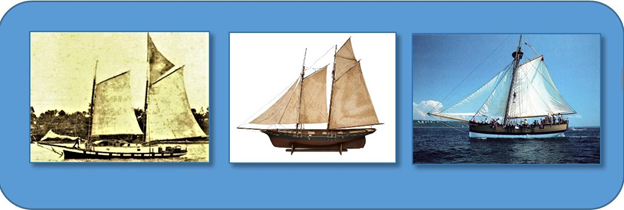
No drawing or detailed description of the sloop survives except for the title and the capacity of “six to seven tons.” As an aid to our creative imagination we provide the images below of such sloops that often were single masted but occasionally sported twin masts and ranged from 30 to 40 foot in length with sails fore and aft. Several prior mentions of a Sloop Amelia appear in the shipping news. One interesting account tells of a lightning strike in New Orleans that did extensive damage a few years earlier. Perhaps the more superstitious might have taken such an event as an evil omen, but on this occasion the happy group were oblivious to such dark clouds of superstition as well as the real storm brewing over the horizon of the Gulf waters.
The Tragedy

Ben Moates was found, washed up on shore in Pensacola, half dead. He had clung to a hatch to stay afloat through the raging gale. He told, as he recovered, of hours of the captain and crew fighting the storm and struggling to keep the ship afloat only, at last, to be capsized and flooded when the hatches were ripped from the holds. He had tried to save a woman (presumably his sister) and her child, but failed when they were torn from his grasp and drifted away to their death. In all, eight souls perished, claimed by the implacable fury. He, like a real-life Ishmael, alone survived to tell the tale. I have wondered if Ben spoke much of his harrowing misadventure in the remaining 56 years of his life. He left no known children to tell us, since his only child with wife Nora Thompson Moates died at birth. I suspect that he may have been troubled with survivor’s guilt, but we cannot know. Nevertheless, the event did not put him off venturing out to sea again apparently for he continued his career as a fisherman.

The Aftermath
Grief like the waves on the white beaches of northwest Florida came in pulses in the weeks following the tragedy. Bodies were discovered from time to time for the next several weeks on the beaches from Pensacola to Dauphin Island near Mobile where I was born 50 years later. The first found were the corpses of two of the Constantine boys Nicky and Tony, one on each shore of the entrance to the harbor at Pensacola along with the stern board bearing the ship name Amelia. In the coming weeks, Mr. William Stevens diligently searched for his wife and daughter. He responded to each announcement of a body encountered, often with great disappointment. Ultimately, he apparently did recover the remains of his drowned wife Mary Francis and daughter Lettie. The only other body, greatly decomposed, to come ashore was identified by jewelry to be those of Carrie Moates Constantine. The other three individuals were never see again: Captain John Constantine, Christopher Samiotes, and the unidentified child of Carrie and John Constantine.
The bodies that the sea gave back were interred in St Andrews and their names were engraved in stone on their headstones. They faded from memory anyway as those who knew and loved them passed, themselves. First to succumb was Francis Marion Moates, who was already an invalid in 1895 (possibly as a result of his imprisonment during the Civil War), Alternatively, he may have been overcome by the tragedy of losing two of his beloved daughters and four of his grandchildren in a single blow. He died about six months after the accident, as noted in his death notice in the local paper.

His death left Mary a widow, at age 55, caring still for three minor children at home. Mary Peel Moates had already been through much in her life. As a new mother of two in 1864 she endured the raid on her hometown of Eucheeanna when Union General Ashtoth’s troops occupied and stripped the countryside of food and horses, liberating the enslaved people and leaving her destitute. And she endured with apparent equanimity the latest blow to her family just two days before the 38th anniversary of her marriage to Francis Marion. Not content to play the victim, Mary applied for a widow’s pension on 7 Nov 1897 very soon (if not days before) Francis’ death. With the help of her grown sons she provided for the family, Three years later, in the 1900 Census she is enumerated as “Head” with her sons, including Ben, listed as “fishermen.” Twenty-three years later we find grandmother Mary Moates residing with the family of her youngest daughter Annie Moates Porter. In 1928, Mary Rebecca Peel Moates died in St. Andrews, Florida, surrounded by family at the ripe age of 86.
The Take Away
As I contemplated this tragedy I was reminded of Psalm 107.

And the words of Job seem apropos as well to the stoic character that Mary seemed to exhibit.

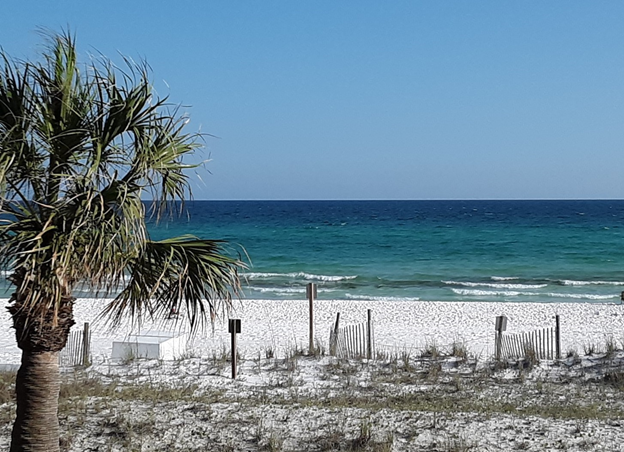
Yet, I am astonished at the way the knowledge of the great tragedy has affected me 126 years after the fact. I was particularly struck by their loss as I gazed out on the Gulf of Mexico while vacationing with my wife and son’s family in Ft. Walton Beach, Florida, on Okaloosa Island halfway between St. Andrews and Pensacola. Perhaps the lesson we should take away from this story is this: life is precious and brief. We sail upon its surface with no guarantees of success. I here renew my resolve not to take a clear day and a fair wind as my right or as a given but, rather, as a gift, a grace. May we not squander our time here in meaninglessness and pettiness, and thus the memory of those who were lost that March Sunday will continue to be a blessing to us today.
 Sam Matteson
What a heartbreaking life story of our dear relatives. Thank you so very much for bringing this to light, allowing me to know a bit more about this part of my family.
Nice