In 1793 Noah Moates, I believe, was born to William Chesley Moates Sr. (1760-1830) and Rachel Adams Moates (1763-1830), descendants of Huguenot immigrants from France who were residing in the 96 District (after 1800 Abbeville County) of upcountry South Carolina. Responding to the urges of “Alabama Fever,” Noah at about the age of 27, along with his young bride Elizabeth Pilcher Moates (1796-1874) and infant son William (1815-1849), began his westward journey on the Fall Line Road across Georgia to the Federal Road to Macon and Columbus, Georgia and on to Montgomery County, Alabama. The first direct evidence of Noah’s presence in Alabama appears as a record of his appointment as Justice of the Peace for Montgomery County in 1825. Indirect evidence comes from the later census-documented 1823 birth year of daughter Rachel (1823-1872) that is universally reported to have occurred in Alabama. She was the mother of my mother’s grandfather, James Marion Moates (1843-1921) by an illicit affair with William Goodman Miley of Pike County, Alabama.
Noah settled on and later patented a half-quarter section near Little Sandy Creek in Montgomery County, Alabama on 16 Sept 1831. The legal description of this aliquot is East Half Southwest Quarter Section 6 Township 13 North Range 20 East. (Abbreviated E½ SW¼ 13 N 20 E 6). The land had previously been purchased and held in 1819 by a Carey Motes of Abbeville, S.C. (Carey may have been a kinsman of Noah, but the relationship is unclear) Nevertheless, apparently Noah Moates rented and resided on the land until he purchased it. The ownership of the tract subsequently (after about 1853) transferred from Noah Moates to Martin Willis (1825-1866), and—on his death—to his heirs: wife Sarah Ann Ingram Willis (1829-1895) and son Asa “Acie” James Willis (1860-1946). The latter held the property until he sold it in 1899 to Thomas Jefferson Gray (1864-1937), upon whose death the tract passed to William Chappell Gray (1901-1978). The bequest by T. J. Gray, who had no living children, to his nephew Chappell angered Chappell’s relations according to W. C. Gray’s step daughter but the diligence of the younger Mr. Gray in paying off the debt on the property assuaged any doubt of his intent and resolve. Indeed, Chappel held the property to the end of his days. Chappell Gray was a colorful character in his own right, one who overcame legal troubles for bootlegging in the 1920s to become a long-time county commissioner and widely respected and successful cotton planter. Following his death, the estate of W. Chappell Gray sold the property to H. R. (Robert) Dudley of Dudley Bros. Lumber in 1987, the current owners. Interestingly, a farmhouse survived on the property at least until 1971 as shown in the aerial photograph below. It was located at 32.13193° N, 86.09279° W.
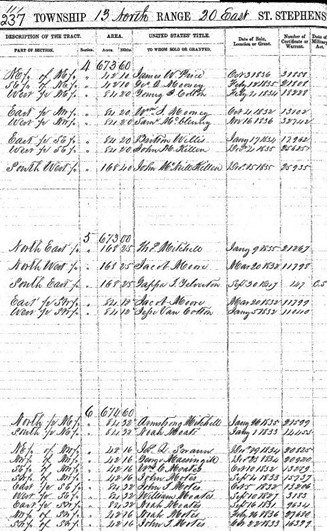
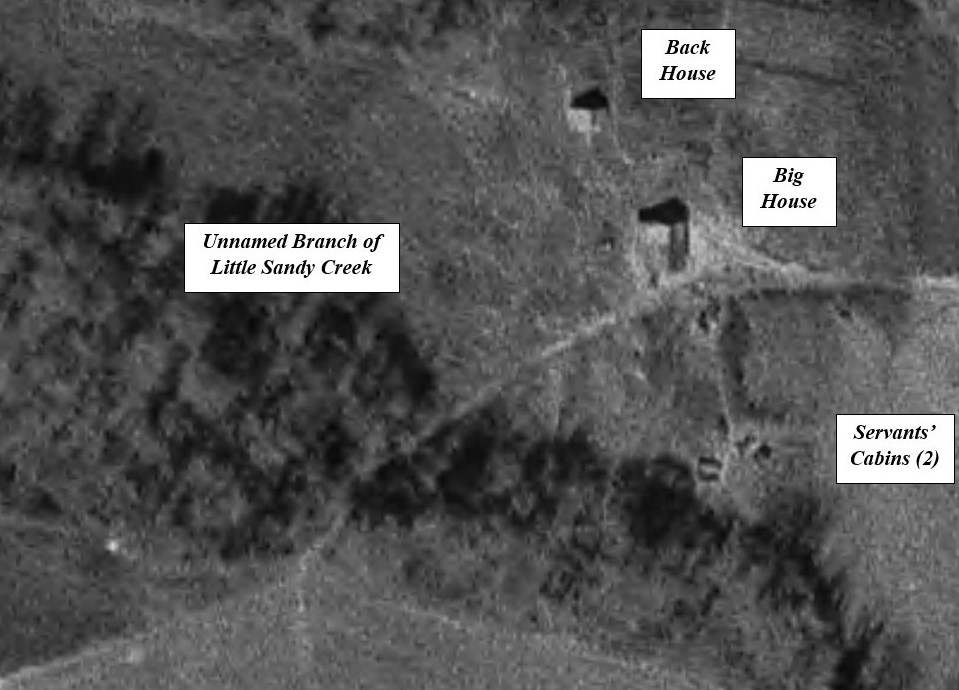
The Little Sandy Creek Farm, Montgomery County, Alabama
On 21 May 2023, I, the author Samuel Matteson (with permission of the owners), visited the site of the former structures. Evidence of the demolished buildings remained. I believe that near this spot all of the children of Noah Moates were born [except for William and the possible exception of Francis Marion Moates (1837-1897)]. This assertion includes, notably, Rachel Moates (1823-1874), mother of James Marion Moates and great-great grandmother of the author. A rubble pile of chimney bricks and a debris field is all that remain. Twentieth-century trash such as abandoned kitchen appliances are sad evidence of the buildings that once graced the farm.

A Move to Briar Hill, Pike County, Alabama
In 1836 hostilities broke out between a bellicose faction of the Creek Indian Nation and Euro-American colonizers. This threat may have been in the mind of Noah Moates, in about 1835, when he moved from his farm in Montgomery County (the Little Sandy Creek Farm) to occupy a leased acreage about 15 miles farther south in Pike County.
While it is hard to know for sure Noah’s motivations, the locus of the conflict later called the “Second Indian War” was indeed near the Alabama-Georgia border east of Montgomery city, not far away. We can establish that about that time Noah moved to an as-yet-unidentified location near Briar Hill (Township 11N Range 19E). It was probably here that Francis Marion Moates was born in 1837 and where, six years later, James Marion Moates (named in part for his toddler uncle) first saw the Alabama sunlight on 3 Nov 1843. As we asserted earlier, James Marion “Miley” Moates was the offspring of an illicit affair between his mother Rachel Moates (1823-1874) and a married man, Deacon William Goodman Miley, co-founder of the Pisgah Primitive Baptist Church just a few miles from the farm on which the Moates family likely resided from about 1835 to about 1849. (Elsewhere in earlier posts in this blog under the general title “Tell Me Thy Name” I have detailed how we have come to this conclusion. The interested reader is refered to that discussion. Our purpose here is a chronicle of Father Noah Moates.) In the aftermath of the presumed scandal surrounding James’ birth, both the Moates family and the Miley family decamped from the community. The Mileys headed to Tampa, Hillsborough County, Florida. At about the same time In 1850 Noah Moates and family appear in the census for Eucheeanna, Walton County, Florida. Meanwhile, Rachel and James were living under the name “Miley” nearby in Walton County. Interestingly, an 1849 advertisement claimed “Valuable Land” offered in Eucheeanna with generous terms: quarter down and one quarter annually for the remaining three years. Thus, if Noah Moates bid on the property in December 1849 and made the down payment in early 1850 for a tract in Eucheeanna, he would have finished payment in 1853, as he is recorded doing. The patent was awarded four years later for several acres near the confluence of Folks Creek and White Creek about one mile west of the Euchee Valley Presbyterian Church. The advertisement shown may be the one Noah Moates actually saw and to which he responded.
A New Home in the Euchee Valley on the Banks of White Creek
The legal description of the likely boyhood home of James Marion Moates in Eucheeanna, Walton County, Florida is Northwest ¼ of Southwest ¼ Section 6 Township 13 North Range 20 East (NWSW 13N 20E 6). The “ole swimmin’ hole,” as the current owner referenced the confluence of Folks Creek and White Creek, is located on the property and is shown in the photograph. The location is familiar to the current owner Mr. James Armstrong (age 84), who swam there as a youth and also was probably a very familiar sight to James Marion a century and a half earlier. The property remained home to the Moates family for decades, even after Noah expired near the end of the Civil War. Those in residence at the farmhouse on 24 Sep 1864 saw a Union detachment invade the town and “requisition” all livestock and provisions in the area. The winter months that followed must have been lean times for them, indeed. Moreover, I conjecture that the mortal remains of several family members are buried somewhere on the property in unmarked graves, albeit a fact that is as yet unconfirmed. In happier times it was here in February 1866 that my great grandfather James Marion Moates married Ruth Ann Dew, daughter of the Preacher Thomas Spenser Dew.


Thus, a life—that began in South Carolina—ended in the community of Eucheeanna, Walton County, Florida. Along the way he and Elizabeth sired a family of three daughters and three sons: Rachel Moates, Martha Jane Moates Teal Lassiter, Sarah Elizabeth Moates Hutto, William Moates, James W. Moates, and Francis Marion Moates.
What Motivated Noah’s Odyssey?
The question naturally arises: “What motivated the odyssey of Noah Moates?” “Alabama Fever” was rampant in the Carolinas in the 1820s. Apparently, it was particularly epidemic in the Moates family, since several of Noah’s family members moved to the region at the same time, notably his immediate neighbors William Chesley Moates Jr. (brother) and John T. Moates (uncle or cousin), and Morris Motes (cousin) and Morris’ brothers. Noah’s brother Jonathan Moates also accompanied his elder brother on the journey and interacted frequently over the decades, sometimes even as a member of Noah’s household.
“Land!” was the source of the infection, indeed. Verdant, virgin, affordable soil was to be had in the areas recently offered by the government that it had wrenched from the control of the newly dispossessed indigenous inhabitants. But after about fifteen years of cultivation in the manner of the early 19th century agriculture the sandy soil of Noah’s Montgomery County farm probably became exhausted and crop yields declined. It would be nearly a century before scientific methods of agriculture would be pioneered by—ironically a black man, Booker T. Washington—and show the way to sustainable yields. Moreover, the years of 1830-40 saw heavy rains and poor crops in Alabama. The Little Sandy Creek property is still prone to flooding and is often described as a “swamp.” In fact, in the 20th century at least two individuals perished after becoming mired in the trackless swamp of the Little Sandy Creek woods. Thus, while he still retained ownership of the Montgomery County property (son James Moates is listed as head of household in Montgomery County in 1840), Noah also leased a farm near Briar Hill, as documented in the 1840 Census for Pike County. It was here that Rachel Moates, his eldest unwed daughter, was “found with child.” Five-to-six years after James Marion Miley Moates was born, Noah moved his family to the thriving community of Eucheeanna in Walton County, Florida. Perhaps a little bastard “Miley” running about the community was too great a shame to endure. In any case, sometime soon after 1850 Noah Moates sold the Montgomery County property to Martin Willis and reinvested the proceeds in over 200 acres in the Euchee Valley. In Florida the family grew and endured, spreading in the following decades throughout northwest Florida and southeast Alabama. Noah died sometime about 1864, followed a few years later by his widow Elizabeth after 1870, who had lived in the Argyle home of their son James W. Moates in her final days.
After Mr. Miley died, although she was under no legal obligation to remain unwed during his lifetime, Rachel Moates “Miley” married a Mr. Gleason of Eucheeanna. He was probably the elderly, blind father of Phillip Gleason who appears in the 1860 Census. In the 1870 census we find Rachel Gleason residing with her son James and his wife Ruth Ann Dew Moates in Eucheeanna, soon after their first infant Mary Ann Moates had died. In the succeeding years she vanishes from the historical record, presumably laid to rest on the family farm of her father..
The Meaning of Land to a Southerner
Land was always the attraction and the goal of our pioneer ancestors. It meant status as well as survival. Indeed, the earth was ever the source of their sustenance as farmers and was inevitably the ultimate destination of their bodies as mortals.
 Sam Matteson
Leave a comment